
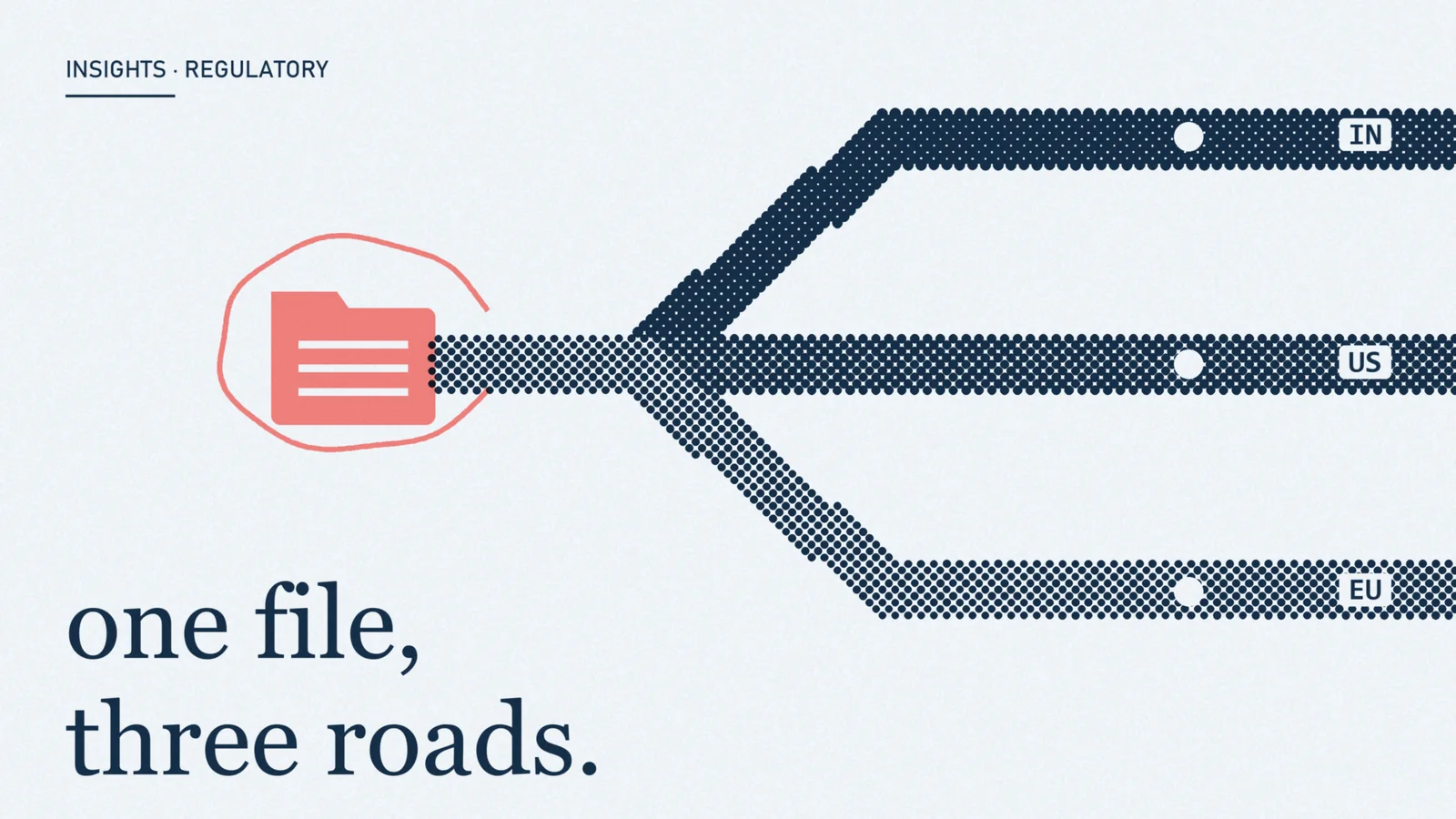
A device that will be sold in more than one market has to be classified, and approved, in each of them. The good news is that the evidence underneath is largely the same: the risk file, the test reports and the design records. What changes is the class, the regulator and the shape of the submission.
India
CDSCO administers the Medical Devices Rules, 2017. Devices fall in classes A to D. Classes A and B are licensed by the State Licensing Authority and classes C and D by the Central Licensing Authority. A manufacturer holds a licence to manufacture; an importer holds a licence to import.
United States
The FDA sorts devices into classes I, II and III. Most class I devices are exempt from premarket notification. Most class II devices reach the market through a 510(k), which shows the device is substantially equivalent to a legally marketed predicate. Class III devices need premarket approval (PMA), with clinical evidence of safety and effectiveness. A novel device of low to moderate risk with no predicate can use the De Novo route.
European Union
The EU Medical Device Regulation 2017/745 uses classes I, IIa, IIb and III, set by the rules in its Annex VIII. Class I devices are self-declared by the manufacturer, except where they are sterile, have a measuring function or are reusable surgical instruments, when a notified body reviews those aspects. Classes IIa, IIb and III all need a notified body. The device carries the CE mark once conformity is shown.
Planning for more than one market
- Classify in every target market at the start. The highest class among them usually sets the evidence you need.
- Build one design file. Requirements, risk management, verification and validation are written once and referenced by each submission.
- Pick standards that are recognised everywhere. ISO 14971, IEC 60601-1, IEC 62304 and ISO 10993 are used across all three systems.
- Look for a predicate early if the US is a target. Whether one exists decides between a 510(k) and De Novo.
This article is a general guide, not a regulatory determination. Each market's rules and its current guidance decide the class and the route for your device.