Innovator-partnered startup
An engineering-led startup with a working concept and no medical device quality system behind it. Co-Design & Develop takes it to a compliant product, with invention harvesting and patent drafting running through the build.
- Where it ends
- Co-Commercialize.
Is this you?
You are an engineer or entrepreneur with a working prototype, and you need to turn it into a medical device.
A prototype that works
A bench or demo build that shows the principle, often made by founders with an engineering background.
You need medical-grade design
Requirements, a risk file, verification and a regulatory route, which a demo build does not have.
You worry about what to protect
New ideas that appear during development, and no clear plan for which ones to file.
Where innovator startups go wrong
- 01
No clinician in the design
A device designed without the people who will use it misses how it is held, cleaned and used under pressure. Clinical input belongs in the requirements.
- 02
Consumer habits in the code
Firmware and apps built the way consumer products are built lack the records a regulator expects. Medical device software follows a lifecycle standard, IEC 62304.
- 03
Filing only the first idea
Development often produces new inventions: a mechanism, a method, a way to make the part. If nobody records them, they are never filed.
A working prototype is not yet a medical device
A prototype shows that the idea can work. A medical device also needs written requirements, a risk file, verification against those requirements, and a design that can be made the same way every time under a quality system. The design often changes as that work is done, so plan for the prototype to be redesigned rather than copied.
What to have ready, and what you leave with
Have ready
- Your prototype and the test results so far
- The intended use and the users you have in mind
- Any patent filings or public disclosures made so far
- Your funding position and the market you aim for first
You leave with
- A verified device and its design history file
- Patent filings on the inventions the development produced
- Units made under a manufacturing licence
- A launch plan for your first market
Your path from here
- Step 1
Turn the prototype into a design
Requirements, risk file and a design that can be made and verified.
Co-Design & Develop - Step 2
Record what the design adds
Capture the inventions that come up during development.
Co-Innovate - Step 3
File the patents
Support for drafting the filings with your patent attorney.
Co-Design & Develop - Step 4
Verify the design
Tests that show the device meets its requirements.
Verification & validation - Step 5
Move it into production
Design transfer, then pilot and production batches.
Design transfer - Step 6
Launch and sell
Regulatory, distribution and sales work for the first market.
Co-Commercialize - Where it ends
Co-Commercialize
Questions founders ask
Who owns the IP and the product?
Ownership, including of inventions made during development, is agreed in writing before work starts.
Can you use our existing prototype?
It is the starting point. Expect parts of it to change once requirements and risks are written down, because a demo build is rarely made the way production will make it.
Where do clinicians come in?
In the requirements, the usability work and the design reviews. The users of the device shape what it must do.
Does our software need to follow a standard?
Medical device software is expected to follow a lifecycle standard, IEC 62304. Standards that shape design lists the ones that apply most often.
Which market should we file in first?
It depends on your buyers and your funding. India, US and EU routes compares the three most common ones.
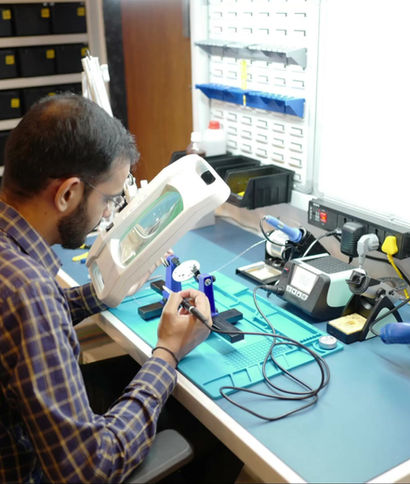
Nine disciplines in one team
Industrial design, mechanical, electronics, firmware, software, verification and regulatory work sit in one team of 41 engineers in Navi Mumbai. We have designed and developed 40+ devices.
Devices we have worked on
We name the type of device, not the client. Client work stays confidential. See every device type.
- Wearable multi-vital monitoring patch
- Skin temperature monitoring patch
- Diagnostic-support software built on a clinical data platform
Run under an ISO 13485:2016 quality system certified by TÜV SÜD, certificate 99 400 00046. What it covers.
Not quite you?
Three free tools that run in your browser and send us nothing: a readiness check, an intended use builder and your likely class and licence.