
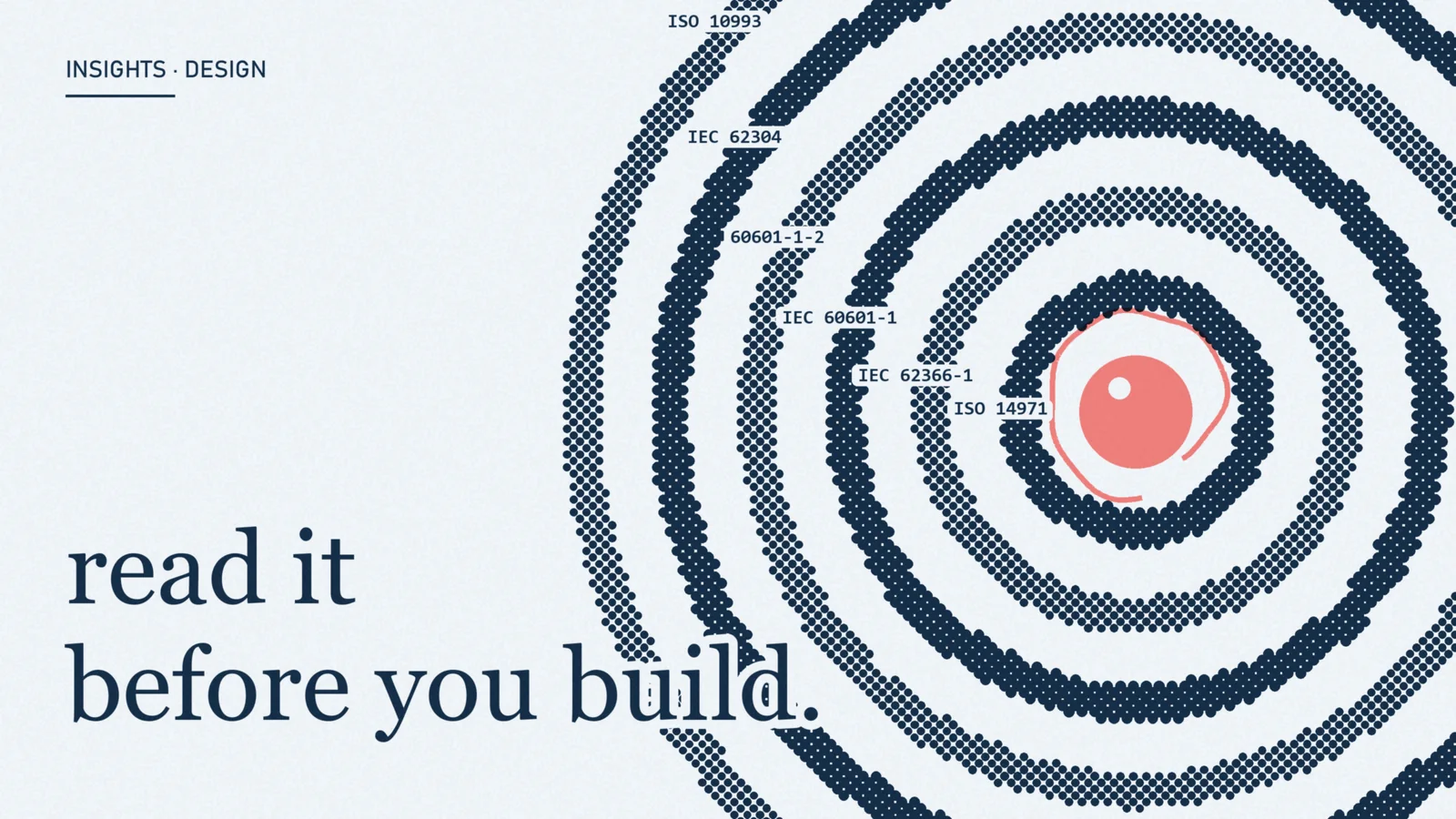
A test lab checks a finished device against a standard. But the same standard has usually decided part of the design months earlier, and a requirement found at the lab is a redesign. The chart shows when each of the six starts to shape the work.
ISO 14971: risk management
What it asks. One risk process across the whole life of the device: identify the hazards, estimate and evaluate each risk, control it, and check that the control works. Where it shapes the design. From the first concept review, because a risk control added late is usually a design change. What it leaves. The risk management file, kept alive after launch with information from production and the field.
IEC 62366-1: usability engineering
What it asks. Define the users, the uses and the use environments, find the use-related hazards, and test the user interface: formative evaluations while you design and a summative evaluation at the end. Where it shapes the design. The layout of controls, the labels, the alarms and the instructions. What it leaves. The usability engineering file.
IEC 60601-1: basic safety of medical electrical equipment
What it asks. Insulation and separation between parts, as means of protection for the operator and for the patient, and limits for leakage current, among much else. Where it shapes the design. Creepage and clearance distances fix the board layout and the enclosure, so they belong in the design inputs before the first schematic. What it leaves. The test report and the risk file entries it depends on.
IEC 60601-1-2: electromagnetic disturbances
What it asks. Limits for what the device emits and levels it must withstand. Where it shapes the design. Grounding, shielding, filtering and cable choices, which are cheap on the first board and expensive after it. What it leaves. An EMC test plan and report.
IEC 62304: the software life cycle
What it asks. A process for medical device software, scaled by its safety class, A, B or C: a development plan, requirements, an architecture, verification in proportion to the class, and control of software from third parties. Where it shapes the design. The plan must exist before the code. What it leaves. The software documentation set, maintained through the product's life.
ISO 10993: biological evaluation
What it asks. An evaluation of every material that touches the body, planned by the nature and the duration of the contact (Part 1). Where it shapes the design. Material choice for every patient-contacting part. A material with an existing history of use can save tests; a late change of material can repeat the evaluation. What it leaves. The biological evaluation plan and report.
Common mistakes
- Reading the standard at test time. Read it when the design inputs are written, and turn its clauses into requirements.
- Choosing materials for cost alone. A cheaper polymer with no biocompatibility history can cost more in testing than it saves.
- Writing the software records after the code. They are slow to make and weak as evidence.
- Leaving usability to the end. A summative failure means rework of the interface, the labels and often the instructions.
Which standards apply, and which edition, depends on the device and its markets. Confirm the list for your device in its regulatory plan.