
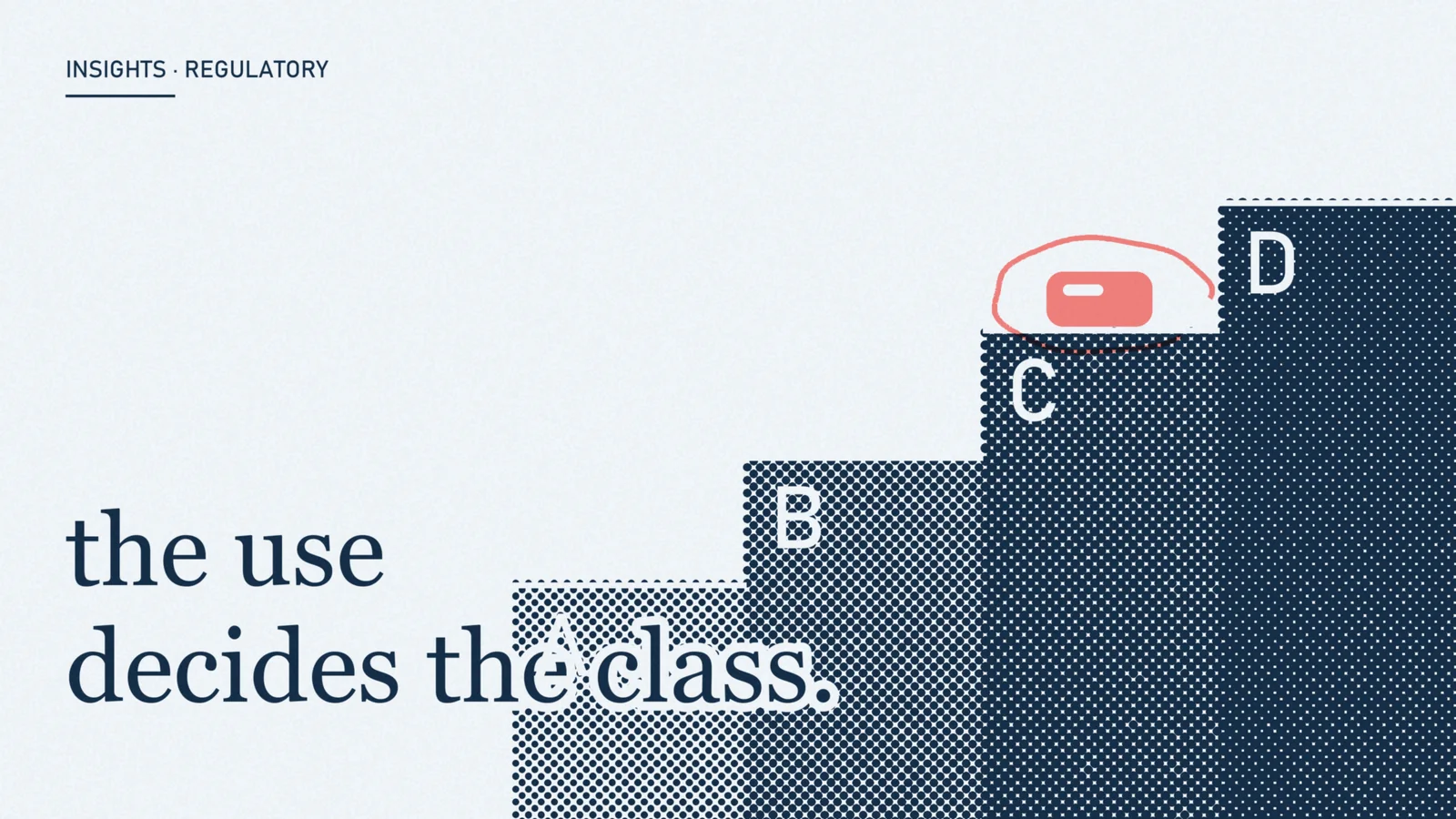
Under the Medical Devices Rules, 2017, every medical device sold in India falls into one of four classes, by the risk it carries for the patient and the user. The class decides which authority grants the manufacturing licence, on which forms, and how much evidence the application has to carry.
What decides the class
The class comes from the classification rules in the First Schedule of the Rules. They are applied to the intended use the manufacturer states for the device: what it is for, on whom, where on the body and for how long. Two devices built on the same technology can land in different classes because they are claimed for different uses.
The duration of contact is defined in the Rules themselves. Transient means normally in continuous use for less than sixty minutes, short term for not more than thirty days, and long term for more than thirty days. Longer contact, deeper access to the body and contact with the heart, the central circulation or the central nervous system all push a device up the scale.
In-vitro diagnostic devices follow a separate set of rules, based on the risk that a wrong result carries for the patient and for public health.
Check the published lists
CDSCO publishes lists that name device types with their class. If your device type is on a list, start from that entry, and check that your intended use matches the one the entry describes. If it does not match, the rules decide, not the list.
Common mistakes
- Classifying the technology instead of the claim. A sensor does not have a class; a device claimed for a use does.
- Stopping at the first rule that fits. Several rules can apply, and the highest class wins.
- Forgetting the accessories. An accessory is classified in its own right, separately from the device it is used with.
- Borrowing a class from another market. A US or EU class is not an Indian class. The systems do not map one to one.
- Changing the claim late. A new indication, a new body site or a longer contact time can move the class, and with it the evidence.
What goes with the application
A manufacturing licence application carries a Device Master File for the device and a Plant Master File for the site where it is made. To make a device for clinical investigation, testing or evaluation before a manufacturing licence, the route is a test licence: apply on MD-12, and the licence is issued on MD-13. To import a device, apply on MD-14, and the licence is issued on MD-15.
When to decide
Settle the class when the intended use is first written, and check it again at every design review that touches the claim. The class sets the standards, the tests and the clinical evidence, so a class found late is a plan rebuilt late.
This article is a general guide, not a regulatory determination. Confirm the class of your device against the Rules and the current CDSCO lists before you plan around it.