

Embedded firmware & BLE
The firmware inside the device, written under the IEC 62304 lifecycle. Battery life, wireless reliability and update security are design decisions, not later fixes.
When embedded firmware and BLE are the right step
When a device has a microcontroller, a wireless link or a battery life to meet. The firmware is medical device software, so its process follows from the risk it carries.
Connect a device to a phone
A wearable or bedside device that sends data over Bluetooth Low Energy to an app or a gateway.
Make a battery last
A device that must run for days or weeks on a small battery, where sleep modes and radio use decide the design.
Secure the device
Pairing, encryption and firmware updates that protect patient data and guard the device against tampering.
What you bring, and what you get back
You bring
- What the device does, and how long it must run
- The hardware, or its schematics
- The risk analysis so far
- The app or gateway it must talk to
- Any existing code, and the third-party libraries in it
You get back
- Software development plan
- Architecture and detailed design
- Unit and integration test records
- List of third-party software (SOUP)
- Security controls and their records
- Release notes for each controlled release
The software safety class follows from risk
IEC 62304 sorts software into class A, B or C by the harm it could contribute to. Class A: no injury is possible. Class B: a non-serious injury. Class C: death or a serious injury. The class decides how much design, testing and documentation the standard requires, so set it before the code is written. A risk control outside the software, such as a hardware cut-out, can lower the class.
How embedded firmware and BLE work
Questions clients ask
Is our firmware medical device software?
If it runs on a medical device and affects how the device works, yes. IEC 62304 then applies to how it is developed and maintained.
What is SOUP?
Software of unknown provenance: third-party code, such as a real-time operating system, a Bluetooth stack or a library, that was not built under your process. IEC 62304 asks you to list it, state what you need from it and assess its known faults.
Do we need Bluetooth qualification?
A product that uses Bluetooth technology and its name or logo must complete the Bluetooth SIG qualification process. A pre-qualified module can reduce the work.
Can firmware be updated after release?
Yes, if the update process is designed in: signed images, a safe fallback if an update fails, and each release under configuration control. Each change is also assessed for its effect on safety.
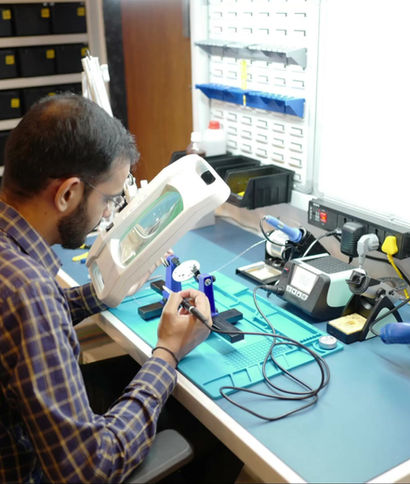
Firmware beside the hardware
Embedded engineers work in one team of nine disciplines with electronics, software and verification, at our design office and labs in Navi Mumbai.
Devices we have worked on
We name the type of device, not the client. Client work stays confidential. See every device type.
- Pulsed lavage irrigation system for orthopaedic surgery
- Battery-powered bone drill with its docking station
- Blood and fluid warmer, in two flow ranges
- Whole-body patient warming pad system
- Organ transport system
- Continuous glucose monitoring sensor
Run under an ISO 13485:2016 quality system certified by TÜV SÜD, certificate 99 400 00046. What it covers.
Not quite you?
Standards this work is done against
- IEC 62304Medical device software life cycle
- IEC 81001-5-1Security in the health software life cycle
- Bluetooth SIGProduct qualification for Bluetooth devices
The list for a given device, and the edition of each, is set in its regulatory plan.
Where this sits
Also in Co-Design & Develop
Tools for this
Have a question about Embedded firmware & BLE?
Opens the contact form with this service named. Nothing is sent until you press send.