

Industrial design
How the device is held, read and operated, worked out with the people who will use it and tested against IEC 62366-1 rather than assumed.
When industrial design is the right step
After the concept is proven and before the mechanical detail is fixed. Form, controls and labels are cheap to change here and costly later.

Design for real users
A device used by a scrubbed surgeon, a nurse on a night shift or a patient at home. Each user brings different hands, training and stress.

Give a prototype its form
A working prototype that now needs a form, controls and a finish that people can hold, clean and read.
Build the usability file
Evidence of a usability engineering process under IEC 62366-1, which regulators expect in the design file.
What you bring, and what you get back
You bring
- The intended use, and who the users are
- Your prototype, or the concept you chose
- Complaints or feedback on similar devices, if you have them
- Brand guidelines, if you have them
- Access to users or clinicians for studies, if you have it
You get back
- Use specification and user profiles
- Concept sketches and form models
- Formative usability evaluation records
- Industrial design CAD, ready for mechanical design
- A colour, material and finish specification
- Use-related hazards for the risk file
Formative tests shape the design, the summative test proves it
IEC 62366-1 asks for two kinds of usability evaluation. Formative evaluations run during design, with a few users at a time, to find use problems while they are cheap to fix. The summative evaluation comes at the end, on the finished design, to show that users can do the critical tasks safely. A new problem found in the summative test sends the design back, so problems found early cost less.
How industrial design works
Questions clients ask
Is industrial design just how the device looks?
No. It sets how the device is held, read, cleaned and operated, and each of those can cause a use error. Appearance is one output among several.
Do we need a usability study if the device is simple?
A simple device may need a smaller study. IEC 62366-1 still expects a use specification, an analysis of use-related hazards and a summative evaluation of the user interface.
Can the form change after mechanical design starts?
It can, but each change moves parts, tooling and sometimes tests. Settle the form and controls first, and hand over agreed surfaces, to keep those changes small.
What does the colour, material and finish specification cover?
The colours, materials, textures and coatings of each visible part. For a medical device, each surface must also withstand the cleaning and disinfection agents named in the instructions for use.
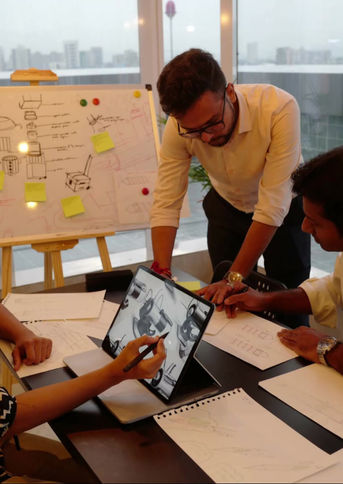
Designers beside the engineers
Industrial design is one of nine disciplines in one team at our design office in Navi Mumbai. The surfaces and usability inputs pass to the mechanical and electronics engineers in the same team.
Devices we have worked on
We name the type of device, not the client. Client work stays confidential. See every device type.
- Pulsed lavage irrigation system for orthopaedic surgery
- Battery-powered bone drill with its docking station
- Suturing device for wound closure
- Manual wound debridement instrument set
- Bipolar coagulation instrument for neurosurgery
- Membrane oxygenator for cardiopulmonary bypass
Run under an ISO 13485:2016 quality system certified by TÜV SÜD, certificate 99 400 00046. What it covers.
Not quite you?
Standards this work is done against
- IEC 62366-1Usability engineering
- IEC 60601-1-6Usability of medical electrical equipment
- ISO 14971Risk management, for use-related hazards
The list for a given device, and the edition of each, is set in its regulatory plan.
Where this sits
Also in Co-Design & Develop
Tools for this

Have a question about Industrial design?
Opens the contact form with this service named. Nothing is sent until you press send.