
Mechanical engineering
The physical device: the parts, how they fit and how they are made, with biocompatibility under ISO 10993 in view from the first material choice.
When mechanical engineering is the right step
Once the concept and the form are chosen. Mechanical engineering turns them into parts that fit, seal, carry load and can be made at the cost you need.

Turn a concept into parts
A proven concept or an industrial design that now needs detailed parts, assemblies and drawings.

Make it manufacturable
A prototype made by printing or machining that must move to moulding or another production process, at a cost that works.
Solve fluid, heat or seal problems
Fluid paths, thermal limits and sealed or sterile-barrier features, where the physics decides the design.
What you bring, and what you get back
You bring
- Requirements, with numbers where you have them
- Industrial design surfaces or a prototype
- Target cost and expected volumes
- Materials and suppliers you already use
- How the device is cleaned or sterilised
You get back
- 3D CAD models
- Released 2D drawings, with tolerances
- Tolerance stack-ups
- Design for manufacture review
- Mechanical test reports
- Bill of materials
Biocompatibility belongs to the finished part
ISO 10993-1 evaluates the device as it is made, not the raw material. Processing, colourants, mould release, cleaning and sterilisation can all change what the body is exposed to. The evaluation depends on the kind of body contact and how long it lasts. A 'medical grade' label on a material is a useful start, but it is not evidence for your part.
How mechanical engineering works
Questions clients ask
Why involve a supplier during design?
A moulder or machinist sees draft angles, wall thicknesses and tolerances that add cost or cause defects. A change in CAD costs less than a change to a tool.
Do we need finite element analysis?
Where a part carries load, gets hot or moves fluid, and its failure could harm someone, analysis helps settle the design before testing. Where a simple test answers the question, a test is often the better choice.
Which parts need a biocompatibility evaluation?
Every part that touches the patient or the user, directly or through a fluid path. ISO 10993-1 sets the evaluation by the type and the duration of contact. Parts with no body contact do not need it.
Can we start with 3D-printed parts?
Yes, for fit and function. Printed parts often differ from moulded parts in strength and surface, so their test results may not stand for the production part.
Engineers in one team
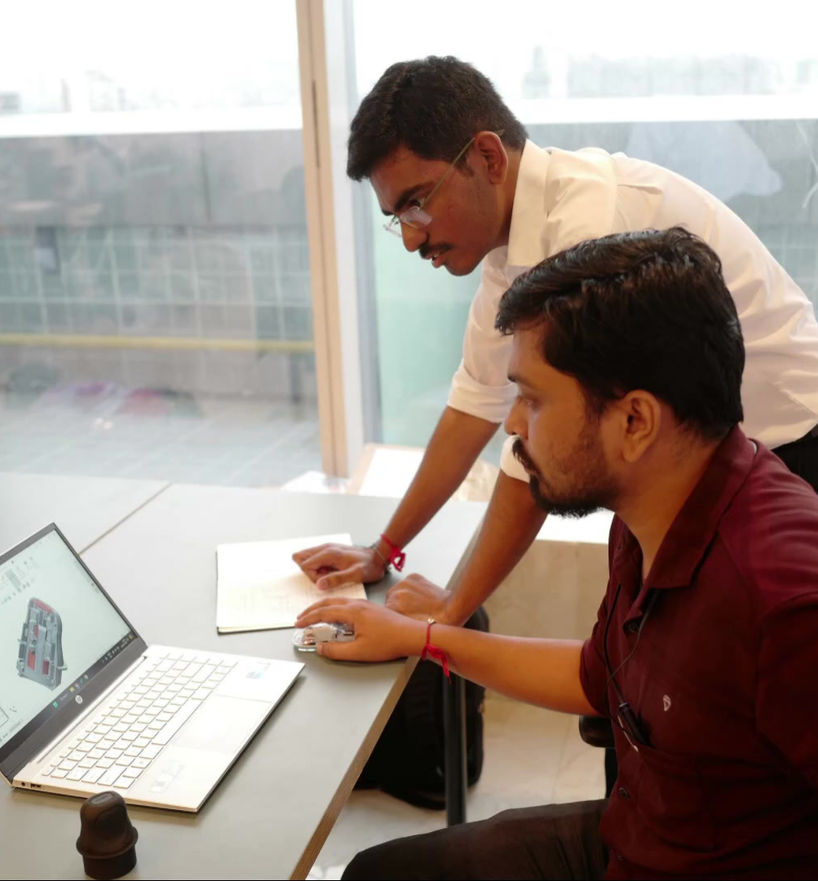
Mechanical engineers work beside industrial design, electronics and verification in one team of nine disciplines, with our design office, labs and assembly in Navi Mumbai.
Devices we have worked on
We name the type of device, not the client. Client work stays confidential. See every device type.
- Pulsed lavage irrigation system for orthopaedic surgery
- Battery-powered bone drill with its docking station
- Suturing device for wound closure
- Manual wound debridement instrument set
- Bipolar coagulation instrument for neurosurgery
- Blood and fluid warmer, in two flow ranges
Run under an ISO 13485:2016 quality system certified by TÜV SÜD, certificate 99 400 00046. What it covers.
Not quite you?
Standards this work is done against
- ISO 10993-1Biological evaluation, for every part that touches the body
- ISO 14971Risk management
- ISO 1101 / ASME Y14.5Geometric tolerancing on drawings
- IEC 60601-1Mechanical hazards, where the device is electrical
The list for a given device, and the edition of each, is set in its regulatory plan.
Where this sits
Also in Co-Design & Develop
Tools for this


Have a question about Mechanical engineering?
Opens the contact form with this service named. Nothing is sent until you press send.